#4: First Tutorial


This week we had our first tutorials. For me this meant an introductory video conference with my assigned tutor and 18 other students, who had turned up (apparently twice that many had signed up to this specific session but didn’t show). Us students are a crazy mix of different degree pathways. Not everybody in my study group has chosen R60 BSc Cyber Security. Some are aiming to become engineers, mathematicians, analysts, software developers, economists, even psychologists – all need a foundational knowledge of IT for their degrees.
Although, the term “video conference” is exaggerated. It really only was a PowerPoint presentation with live audio. I did not see any faces (or videos) of my tutor or fellow attendees. However, it was nice to hear my tutor’s voice, feeding a first impression besides just being told a name.
It seems each module specific tutorial has several dates over a roughly 14day period run by different tutors. You can then choose which days (or tutors) suit you best in the OU booking system and reserve a place. In theory you could attend all of them, even so they cover the same topic; in case you wanted to meet all the other tutors or needed a different way of explaining things. Of course, I wanted to “meet” my assigned tutor and therefore chose the tutorial run by them.
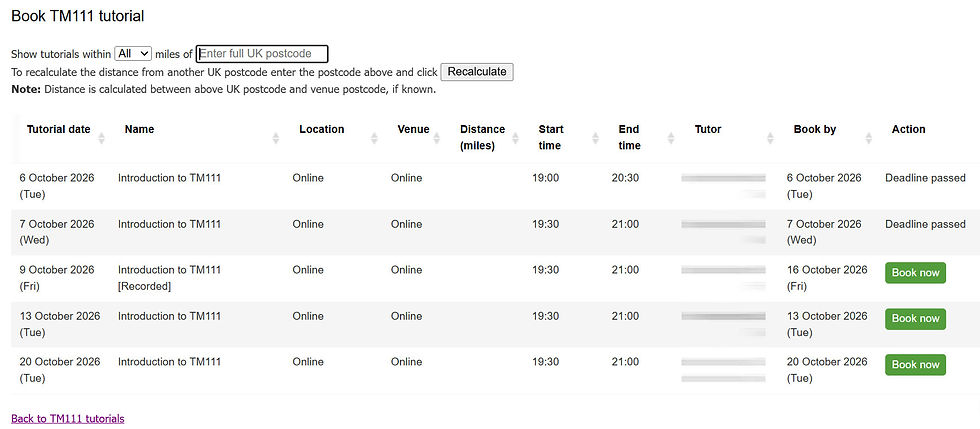
As this was an introduction for the TM111 module, it outlined and explained pretty much what I had already read and been prompted by the OU through my module website or course book. But there were also a few things, which I didn’t know yet.
Here are my key takeaways:
The TM111, together with the following TM112 module, builds a first year solid foundation in IT covering all aspects. So not just programming and coding languages, as many seem to think. It will also build on data management, digital file processing (audio, video), analytics, AI and security tools. I have been reassured, that Python will be covered in the second part of the 12 months foundation, during the TM112 module. TM111 uses Scratch to introduce programming principles. Don’t ask me why... nobody actually uses Scratch, it’s just a very basic tool to teach programming. But why waste people’s time and not go easy on a more useful programming language which could be built upon?
Throughout the module key skills are assessed, i.e. research, referencing, writing professional reports; all building blocks for the very essential DIL (digital and information literacy). The OU has two types of assessments. iCMAs (Interactive Computer-Marked Assignments) and TMAs (Tutor-Marked Assignments). There are three of each and alternating during the TM111, so six in total until March 2027.
The iCAMs are essentially multiple choice questions and interactive quizzes. They can only be submitted once though. But within the one submission, you get up to three attempts in getting the answer right, as each answer can be checked before submission, counting as one attempt.
On the other hand, the TMAs can be submitted more than once. Being a written document uploaded to the OU system, it allows resubmission of your document until the deadline. The tutor however, will only be able to see and mark the latest version, as resubmitting overwrites the previous file.
Naturally, we are forbidden to discuss or reveal any assignment related questions or answers anywhere. However, we are encouraged to ask all other questions in the forums, our tutors, and of course make use of all the resources the OU has to offer.

Again a big and important part of the tutorial was also about netiquette and plagiarism. Nobody cannot say they never were aware or didn’t understand. We have been hearing and seeing about it from all sides. There is an entire section in the course book and on the module website. And I am pretty sure, there will still be somebody who will try using other people’s work and cheat. Because there is always at least one person, right?
On that note, there is also always one, who talks loudly, interrupts or needs all the attention in group settings. No different in my tutorial. To the point it became so disruptive, some students had to call a stop to it, resulting in the disruptor turning sour and unexpectedly leaving the tutorial. In contrast, the tutor was very "British" about it, gently pointing out netiquette, but otherwise not enforcing any actual rules. Surely they have seen all this before and come prepared? Interestingly, via the WhatsApp group, I heard other tutorials experienced similar characters. It must have been quite extreme in their session, as the bitching went on for a while and people were soundly annoyed with such rude and inconsiderate behaviour.
In summary though, it was a good tutorial. I liked the voice of my tutor. It was engaging and didn’t put me to sleep, even so I knew most of what was said and presented to us. It looks like that most my tutorials will be with other tutors though, as my assigned tutor didn’t come up on the list. much Which means I will meet some of the other tutors in the next ones I booked. To be fair, I am curious anyway what they are like and their presentation styles.
On the side: My mock assignment came back with 100 marks, yay! My tutor put some feedback notes in return, although called it “feed forward”. Never heard of this before. What is the difference between feedback and feed forward?


Comments